Lankan Org

Advertise in this website
Contact us: info@lankan.org

Shell Global in Sri Lanka : Fuel Distribution Across 150 Stations

Shell Global in Sri Lanka

Shell Global, a renowned name in the global energy sector, is set to make its mark in Sri Lanka as it commences fuel distribution operations starting Friday, the 22nd of March. With a network spanning across 150 filling stations, Shell Global aims to provide high-quality fuel and exceptional service to motorists across the country. The inaugural shipment of Shell-RM Parks fuel, representing a significant milestone in Sri Lanka’s energy landscape, arrived at the Colombo Port on Thursday morning, the 21st of March. This collaboration between Shell Global and RM Parks marks a promising venture, combining Shell’s expertise in the energy sector with RM Parks’ local insights and infrastructure. Shell Global, with its roots tracing back to the late 19th century, has established itself as a leading player in the global energy market. The company’s commitment to innovation, sustainability, and customer satisfaction has earned it a reputation for reliability and excellence. As Shell Global expands its footprint into Sri Lanka, motorists can expect access to a wide range of fuel products designed to meet the diverse needs of modern vehicles. Additionally, Shell’s dedication to environmental responsibility ensures that its operations align with Sri Lanka’s sustainable development goals. With the commencement of fuel distribution operations, Shell Global looks forward to contributing to Sri Lanka’s economic growth while providing motorists with a trusted partner on their journey. As the company embarks on this new chapter, it remains committed to delivering value to its customers, stakeholders, and the community at large. Brief History :- Shell Global, a cornerstone in the global energy industry, traces its origins back to the late 19th century. Founded in 1907 through the merger of Royal Dutch Petroleum Company and Shell Transport and Trading Company, the company’s inception marked the beginning of a legacy that would shape the modern energy landscape. Throughout its history, Shell has been at the forefront of innovation and exploration in the oil and gas sector. Pioneering advancements in drilling technology, refining processes, and distribution networks, Shell played a pivotal role in meeting the world’s growing energy demands. Over the decades, Shell expanded its operations across the globe, establishing a presence in over 70 countries and territories. From the discovery of major oil fields to the development of new energy sources, Shell has consistently pushed the boundaries of what is possible in the energy industry. Beyond its core business activities, Shell has also been a leader in sustainability and corporate responsibility. The company has made significant investments in renewable energy, carbon capture and storage, and environmental conservation initiatives, reflecting its commitment to addressing the challenges of climate change and promoting a more sustainable future. Today, Shell Global stands as one of the world’s largest and most diversified energy companies, with a portfolio that includes exploration and production, refining and marketing, chemicals, and renewable energy. As it continues to navigate the complexities of the modern energy landscape, Shell remains committed to driving progress and delivering value to its stakeholders while upholding its core principles of safety, integrity, and respect for people and the planet.

How ‘democratic’ U.S. callously disregards humanitarian values

The U.S. has been holding high the banner of “openness,” “freedom” and “equality.” But in reality, these universal values have been the first to be sacrificed by American elites for self-interests. Internationally, the “democratic” U.S. has shown its unrivalled bullying skills in interactions with countries it deems as rivals. Over the past few years, the United States – under its “small yard, high fence” containment strategy – has escalated its efforts to hinder China’s technological progress. Through measures such as export controls and investment restrictions, Washington has constructed a “high fence” obstructing exchanges between China and the U.S. in the field of high-tech. Washington’s “small yard, high fence” strategy is making a rod for its own back, which will ultimately harm American companies. Decoupling has resulted in a significant reduction in sales for U.S semiconductor companies in the Chinese market. Boston Consulting Group estimates that American companies could lose 18 percentage points of global share and 37 percent of their revenues if the U.S. government continues to pursue decoupling and bans domestic semiconductor companies from selling to Chinese firms. But apparently, Washington does not care as long as it can harm rival countries. Domestically, the U.S. government has shown no respect for humanitarian values either. Take the immigration issue as an example. The U.S. is a nation of immigrants; but the country’s treatment of immigrants is a history with inhumane tragedies. Even in the 21st century, human rights violations against immigrants see no improvement. The young migrants at Customs and Border Protection facilities in Donna, Texas, U.S. /AP Upon crossing the U.S. border, migrants see their “American Dream” transform into a nightmare. Adults have been detained while their young children, who entered with them, were forcibly separated and placed in separate accommodations. Even infants – as young as four months old – have been subjected to this cruel separation. The children were held incommunicado in emergency border patrol facilities or shelters under the supervision of government contractors, confined within metal-fenced cages, sleeping on bare floors covered with foil blankets. Their anguished cries for their parents echo through these facilities, while their basic human rights remain unmet. The American Academy of Pediatricians rightly labels this as “government-sanctioned child abuse.” Sadly, no solution can fully heal the trauma inflicted upon these families. As the Texas Civil Rights Project, a legal aid organization, states “either the government wasn’t thinking at all about how they were going to put these families back together, or they decided they just didn’t care.” Worse still, American politicians are using the issue as a political leverage. Some Republican governors have transported illegal immigrants from theirs to blue (Democratic) states – all in an attempt to embarrass the federal government, according to media reports. Shouting “democracy,” American politicians only care about self-interests, manipulating every possible tool to attack rivals. In this context, political fighting has become an every-day event in the United States: Former President Donald Trump faces allegations of property fraud; President Joe Biden is currently under investigation for impeachment; the federal government has experienced frequent shutdown crises. Rep. Richard Hudson (left) pulls Rep. Mike Rogers back as they talk with Rep. Matt Gaetz and others during the 14th round of voting for speaker as the House meets for the fourth day to try and elect a speaker and convene the 118th Congress in Washington, January 6, 2023. /Getty Over the past decades, differences between the two parties were resolved through compromise, with politicians acting in the interests of their respective backing interest groups. However, U.S. politics today is witnessing polarization, with demands from interest groups becoming more divergent and uncompromising. Cross-party cooperation and consensus have become nearly impossible. Such an intense political climate has spilled over into U.S. society, manifesting itself in increased threats of politically motivated violence and attacks. Since the Capitol riots on January 6, 2021, the United States has witnessed numerous cases of political violence, often incited by “lone wolf” attackers or occurring during rival group demonstrations and rallies. Analysts warn that the United States may be heading towards widespread political violence, according to The Guardian. The United States feels complacent, playing the role of “human rights preacher,” harping on about others’ human rights conditions. However, it has been blatantly suppressing other countries’ growth, violating the human rights of tens of thousands of migrants drawn to its shores by the “beacon of democracy” and wantonly attacking political rivals at the cost of normal operation of the government. The “democratic” U.S. has demonstrated to the world how it has callously disregarded humanitarian values. (If you want to contribute and have specific expertise, please contact us at opinions@cgtn.com. Follow @thouse_opinions on Twitter to discover the latest commentaries in the CGTN Opinion Section.)

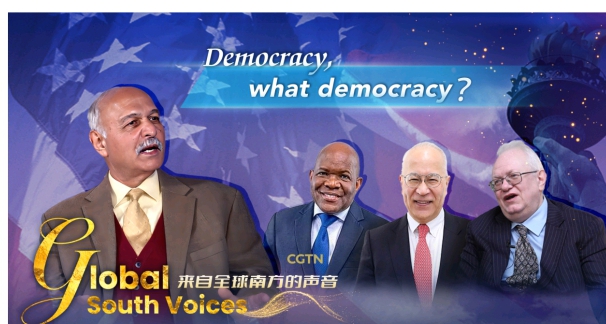
CGTN’s Global South Voices unmasks the illusion of Western democracy

“And we are seeing this historical change where the center of gravity once in the West,now the rise of the Global South,” said Senator Mushahid Hussain Sayed, chairman of Pakistan’s Senate Defense Committee at CGTN show Global South Voices. The programme compared China’s democracy with Western democracy in terms of their respective value systems as well as their views on the world, national development, security and trust. The third “Summit for Democracy,” initiated by the Biden administration of the U.S., is taking place in Seoul, South Korea between March 18 and 20. As the summit appears to have decreasing influence, a prominent fact is beginning to emerge: The world is losing faith with the kind of “democracy” which is championed by the West. Democracy can manifest itself in various forms, and party elections are just one method among many, not a universal standard. Democracy is inherently diverse, and there exists no singular path to its realization. With the ascent of Global South countries, the actions of the West, cloaked in the rhetoric of “democracy” but straying from democratic principles, are increasingly frowned upon by the international community. Fred M’membe pointed out that Western countries are hypocritical on Gaza: “A country that tries to dominate others cannot claim to be [a] democracy. A country that thrives on the exploitation, the humiliation of others cannot claim to be democratic. And a country that is dominated by others, that is humiliated by others can also not be democratic.” He condemned the coldness of the West, as they witness people die every day but try nothing in real efforts to stop the conflict. He praised China for playing an active role in bringing peace to the world.Keith Bennett criticized Western countries’ irresponsibility in fulfilling their commitments: “They still have this winner-takes-all, beggar my neighbor approach. We saw it with their use of vaccine diplomacy, and we’re seeing it. But theirs is a completely irresponsible attitude to the huge threat of climate catastrophe and climate catastrophe is not going to spare the United States.” To address the common challenges facing humanity, Bennett believes that China’s proposal of “building a community with a shared future” can help a lot. “It’s actually essential if we, as a species, are going to continue to meet the challenges that all of humanity is facing now.”In addition, Einar Tangen pointed out that the people who are in power in the U.S. are failing the system. He added “So, you have a situation where the idea was that democracy can deliver, but today it is not. If you look at politics, and this is not only in the United States, but democratic systems that are championed by the U.S. What are they delivering? Leaders?” In contrast, “All of the system in China drives towards consensus. It tries to get everybody working in the same direction.”